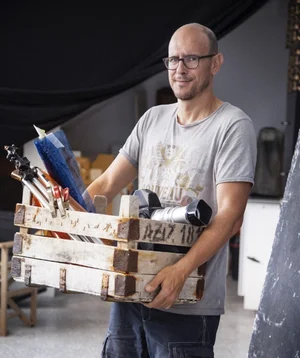
Of ink and words : The art of letterpress printing
“I do like to have a message, but I think you can get more people on your side if you ask a question than when sending messages out.”
I had seen Stephen’s posters in the streets around Fish Island during COVID-19 times.
Beautiful prints with an oversized colour dot in the middle and some Japanese text next to the English one.
But I didn’t know they were his until last autumn when I visited his studio on Dace Road during an open-day event. It’s a small, old-fashioned place that people would call stylish these days, and, indeed, it has a style of its own, as has Stephen himself.
His letterpress printing business is called The Printer’s Devil. For us mortals, this means the printer’s apprentice, the guy who mixes inks, cleans up the type and learns the craft in the process. As a self-educated letterpress printer, Stephen considers himself still an apprentice. I get it, being a self-taught photographer myself.
He’s a soft-spoken, articulate guy who loves American folk music of the 50s ( which I got stuck with myself after the shoot) and has lots of respect for words’ meanings and well-crafted printed paper.
We sat together and had a great chat last December.
Manos: What drew you to letterpress printing in the first place?
Stephen: My journey to letterpress was a straight line. I think I've always been interested in typography,
Those hand-painted signs on walls probably caught my attention quite early. American comics as well. That kind of thing got me interested in typography in general. That was probably when I was about 12 or 13.
I studied fine art at college. I was often using typography or words in my work anyway, I was quite young, probably 22, 23 after college and it was very hard to get work as an artist, so I kind of sidestepped into graphic design. I did a digital publishing course in Hoxton . I did that for the next, kind of, six or seven years. And when my daughter came along in 2008, I was working with some architects as their in-house graphic designer.And then they let me go. That was, you know, the crash of 2008. So I needed something more permanent that I was in control of, so, I dunno, I took a risk. I just started collecting wood type one day.
M: So that's how it happened, right?
S: Yeah. I approached it from the word go as a business. It was never meant to be a hobby. It was always meant to be a proper business. And I wanted to look after my girl as well at the same time at home.
M:But back then, was letterpress a thing,? Or was it, like, something you kind of visualised that it could be a thing?
S: It was around, just a little bit visible. There were a couple of people visible back then. It was just the right time. So the first, kind of ,six months I did get lucky. I got a Tate Modern book cover, I got the V&A and I got Liberty all in the first six months.
M: So you integrated your letterpress thing with your graphic design profession, so to speak.
S: It definitely helped.And you know, the thing with graphic design is that you have limitless amount of choice for font and size and colour and what the rest of it. I never really found that very liberating. I found that a bit of a trap, actually. You see, if you have all this limitless choice, you still end up going for the same font. So I kind of thought, less choice is actually more liberating.
M:Yeah I agree, it’s like Photoshop with us photographers. By the way, here’s a technical question. Does every letterpress work with every letterpress font out there? Or do you have to have a specific kind of fonts for specific presses?
S: Any font can work on any press. As long as you have a big enough press. Or a small enough press. They're all the same type height. So anything can go on my press. You know, limited only to the size of the bed..
M: Do you think the beauty of the letterpress, are the flaws, you know, the wood grain and the ink inconsistencies? Doesn't that make it more humane compared to, like, inkjet print ?
S: Completely, yeah, and I think that's going to be, more and more valuable in the future as well, especially when you get into the AI world which we're almost there now, deep fake and so on. There'll be dual Universes in a few years where you'll have things that are made by hand, clearly handcrafted like ceramics and printmaking and art which are clearly made by hand and are all a bit different. And then you'll have all this other stuff, which is mass produced, or it’s robotic, or it's, you know, artificial intelligence, or whatever.
M: I see it the same way. I think that old methods have an uncontrollable factor of their own. So they are part of the process as creative elements. Things happen that you cannot control over a certain limit.
S: You are constrained by the the physical size of what you've got and the amount of things you have. Yeah. It's not limitless.
M: Okay, so, we talked about those two upcoming universes. What do you feel is the reason that people are drawn to old techniques? People who buy objects made with old techniques, with old methods?[
S: I do that too. I love old books because I know they've been printed by hand, you know, with a metal type. I love all those things. I'm not sure people generally know that's what they've got in their hands, you know, if you pick up a book before well, definitely before 1960, that's been made by hand. That type has been set.
M: Your clients, the people who buy your art, do they appreciate that fact, or they just think it’s just trendy?
S: Don't know if it's trendy…
M: Well, you know, in a way it's like, you know, it's arty.
S: I don't know, it seems to become more important. It's not a trade anymore, so it's more of a craft, so, yeah, it becomes more verified, maybe.
M: Legit...
S: Yeah, it is legit. And it's also, you know, at the end of the day, it's words, you're just talking, you've got a message, you can ask questions and things with it, so, you can make a statement or something like that,
M: Do people actually ask how you make them? When they see you at an art fair or online, do they have questions about the technique?
S: Most people don't know. They assume it's silkscreened. You do get the odd individual who recognises it for what it is. But I think most people don't know, actually.
M: I bet. So, what inspires you as a letterpress printer? Is it people from the past who are amazing at it, or are you just experimenting and stuff just comes out without you consciously knowing where it comes from?
S: There are a couple of letterpress printers who I think are incredible. Well, there's one in particular, Ian Mortimer. Perfect printing and kerning and his use of space font choice and so on is amazing. Incredible. Also, Alan Kitching is much more well-known, but yeah, his style is completely different.
M: Do you sometimes feel that you have to compromise between conveying a message and selling prints?
S: I do like to have a message, but I think you can get more people on your side if you ask a question than sending messages out. I'm all keen to ask questions and things, rather than come to my own conclusion, at least publicly.
M: Say, what brought you to Fish Island and how long have you been around here?
S: I've been here five years, and originally Floyd, my friend Floyd, was in this studio, been here for a few years before me. I started subletting off him, it was ideal. It's a really good space for me. It's my fourth workshop, and it's a small one, but it's the best one I've had. Nice wooden floorboards, lovely light. Yeah, good atmosphere.
M: And obviously, the crowds around Fish Island are much more ...
S: Yeah, there are some interesting people around.The longer I'm here, the more I kind of find interesting people and also in this building as well.
M: So this, this is the actual Bridget Riley Studios building, right?
S: Yeah.
M: It's this organization…
S: Space.
M: Space, right. I think Bridget Riley is still around, isn't she?
S: You know what, I'm gonna have to google that one. I don't think she ever worked here, by the way. Goodness me, she is still alive. She's 92. Woah. Gosh, that's incredible. Born April 24th, 1931. That is a good time to be born. That's nice to know. Yeah, she's 92.
M: Sometimes you do these open studios here right? And obviously the area has changed a lot. Like, lots of new people have moved in. Are people, who live in the new developments here, interested in what's going on, in the artist community of Fish Island?
S: I don't know. There are some people that came in during lockdown to buy prints off me, but It's hard to say, really. Yeah, I did, I did sell some COVID prints to locals. So, yeah, maybe.
M: So your main business, so to speak, is selling the prints, or is it also collaborations with people, for example custom made stuff people order from you or projects with clients or whatever? .
S: All of that. Yeah, all of it. I've worked with some really cool brands like Paul Smith, Uniqlo, Danner, Disney, Doc Martens, I've worked with loads of really well known brands. So yeah, there's those, plus there's workshops and my own prints and commissions.
M: Are you, actively seeking collaborations? Or does it just happen because people love, what you do?
S: Yeah, it's mostly people coming to me. But I have an agent in Japan and I've got one now in America as well. In L. A.
M: Is that a different audience than in the UK?
S: Yeah, completely different in Japan. The message needs to be nice and simple. Pretty positive. Uncomplicated. Because it's mostly a visual thing there. And they just want to get the sentiment right. That's it pretty much.Whereas here I can be slightly more playful I think. The Americans are kind of an ideal market actually. They really do get it
M: Do you only sell through your agents or do you also sell online.
S: I do both. I've got stockists too, but I also sell online.
M: How do you react to people's wishes and preferences? Do you go out of your way if somebody comes up with a poster that you're not necessarily, happy with?
S:I do get that occasionally. I think what I tend to do if I'm faced with something that I don't think works, or it's not very interesting, I'll do it, and then if I've got an idea of my own, I'll do that as well.
M: Funny how letterpress, was the only way things were printed with for about….
S: From the 1450s. Yeah.
M: Yeah, and I mean, even earlier I've read in China some guys had like ceramic...
S: Playing cards might have been the first printed thing. The Chinese were before Gutenberg, but Gutenberg was movable type. That was the difference. He could rearrange things.
M: This is a very rare occasion where a whole industry turned, with time, into art. Usually, it's the other way around. Do people actually understand that? That this is the same thing as a newspaper in the 60’s but in another way?
S: Not really. It's not something that occurs to most people. I mean, they really get it once they start printing.
M: That's what I mean, you do these workshops, so do people realise at some point?
S: Yeah. Finally, when you ink up and you print, it's like, oh, okay, I get it now. And it is a bit like magic, a bit like a, being in a photographic dark room. And it's like, gosh, that's magic. It is literally like magic, I think.
M: What are your plans for 2024? Exhibition-wise or whatever? Do you have anything coming up?
S: Yeah, there's that one around the corner, at the Not for Sale gallery. Me and George are going to put a show together called Two plus Two equals Five, which is from 1984, George Orwell. The character in the book Winston Smith has to believe that two and two really does make five so his brain is kind of broken by this process of torture and repetition. There’s a lot of double thinking around today, people aren't supposed to notice certain things, you know, there's lots of words that changed their meaning suddenly while you weren’t looking…
M: Is that what the exhibition is going to be about?
S: Yeah, it's all about that.
Manos: Great stuff. Thanks mate, that was it then!
Stephen: Oh okay. Good that you stopped me before I got going on that one…(laughs)
This story was shot in December 2023. This post was published in February 2024
Copyright notice.
Copyright for images and text by Manos Chatzikonstantis. No reproduction or usage is allowed in any form or medium as a whole or as parts of the original post. Social media sharing is only allowed as a whole by sharing the story’s link and adding full credits. Please get in touch in case you are interested in the story or in further material about the subject. All rights reserved.